
Demo data. These numbers are illustrative, so you can see how the Research Center works. Real findings appear once enough members have opted in. How this works
Research Center
You're not manifesting alone.
The Research Center is where Manifesting College quietly studies what works — across thousands of people's real practice — and gives the answers back to you, the mentors, and the community.
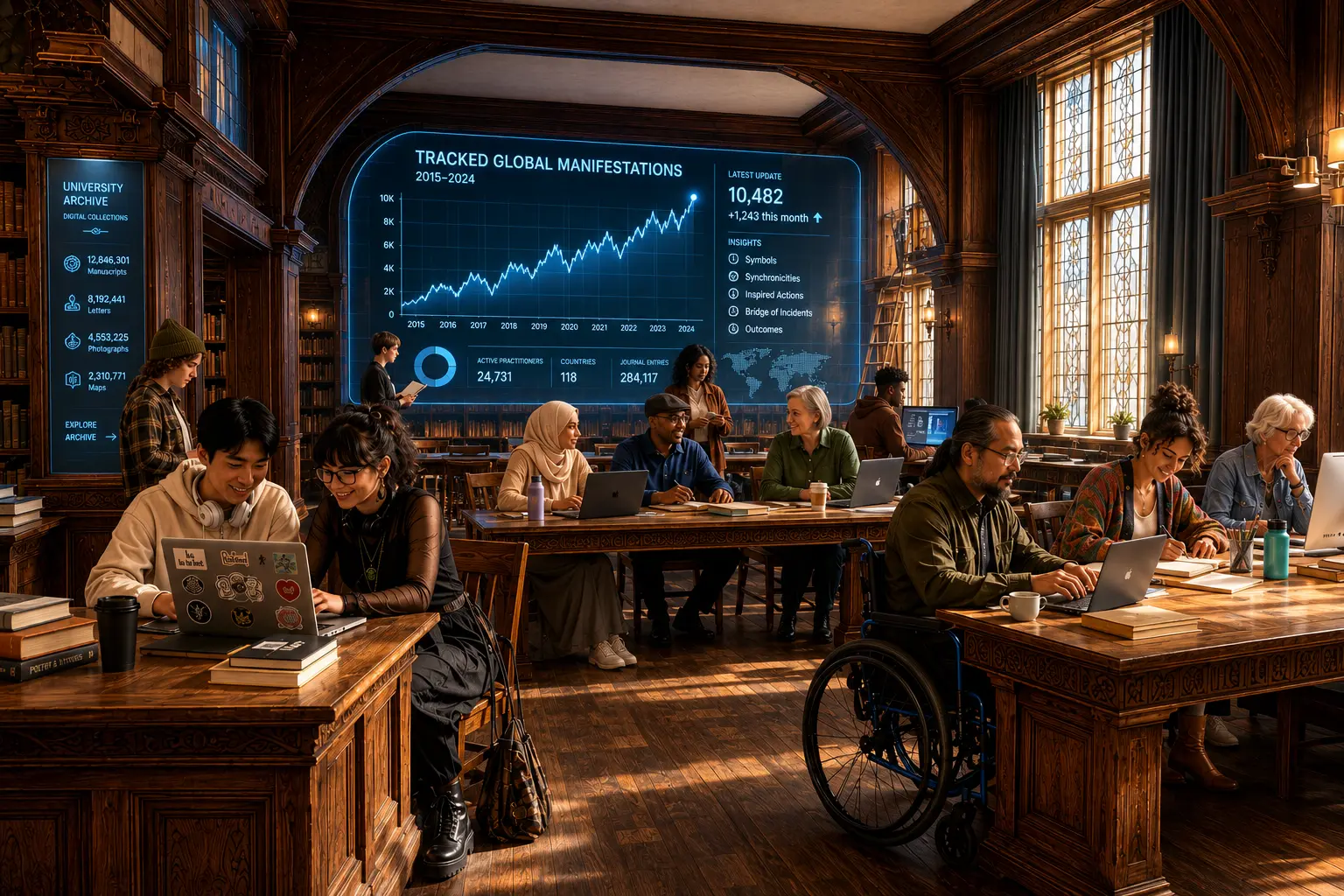
The Research Center pools every consenting user's practice data — privately, anonymously, never identifiably — and uses deep learning and pattern recognition to discover what actually works in the practice of manifestation. This is the first time anyone has been able to look at real manifestation data this way.
If you use the Manifesting Tracker, the engine can show you how your own practice compares to that of thousands of others — what you're doing that's working, what patterns the successful practitioners share, and what the data suggests might sharpen your own results. The mentors learn from it too: when Neville or Murphy speaks to you, what they say can be informed by what the community is actually finding.
- Identify you. Your data is de-identified before the engine ever sees it.
- Publish anything where fewer than ten people contributed to the slice.
- Sell your data, share it with advertisers, or trade it for partnerships.
- Enroll you without asking. The whole thing is opt-in, and you can withdraw at any time.
What's Inside
Seven surfaces, each with a single job. Tap any tile to go straight in.
Findings
What's actually working for people like you.
Patterns our research engine has spotted in how the community manifests, restated by mentors in their own voice.
Live · PersonalYour Mirror
What your own pattern looks like — just for you.
Your tracker data, reflected back to you in a private summary only you can see.
Live · BetaCompare Me
How your List Method pattern compares to people in a similar lane.
A privacy-safe aggregate view of outcomes and List Method practice patterns for people like you. No individual data, ever.
Live · BetaStandard Practice
How people practise with their standard desires, and what tends to land.
Practice rhythm, techniques, what shows up along the way, and how long landing takes. Group figures only, never fewer than ten people.
LiveDashboards
See how the community is moving — without seeing anyone's private business.
Aggregate views of practice and outcomes across users. Never any one person's data.
LiveEngine Status
Look behind the curtain. We show our work.
When we last looked at the data, what models we ran, and what they found.
LiveBecome a Researcher
Are you studying manifestation? You can study with us.
Approved outside researchers can request access to anonymized aggregates.
LiveMethodology
How we keep this honest.
Opt-in only. Aggregate-only. We never publish anything where fewer than ten people contributed.
LiveHistorical Case Studies
What manifestation has looked like in the historical record.
Browseable case studies from Neville Goddard's The Law and the Promise and other documented sources. Clearly labeled as historical, never blended into user-data findings.
Why This Matters to You
Your mentor gets sharper.
When Neville, Murphy, or Troward talks to you, what they say can be grounded in what the community is actually finding — not just what their books said in 1944.
You can see what's working.
Find out whether what you're doing matches what successful practitioners are doing — and where your practice diverges from the patterns the data is surfacing.
You contribute just by tracking.
If you use the Manifesting Tracker and you've opted in, your practice signal joins the pool. No extra effort, no extra forms. Withdraw any time.
How a Finding Gets Made
Four steps from your tracker to a published finding. No magic, no automation that bypasses a human reviewer.
- You and others track your practice in the Manifesting Tracker. With consent, the de-identified signal flows to a separate warehouse.
- The engine looks for patterns across everyone — running deep-learning models against the warehouse, never against any one person's data.
- A human reviews each draft before anything goes public. We check the framing, the sample size, and the voice. No auto-publish.
- Mentors restate it in their own voice, in their own rooms. Same finding, said the way Neville would say it, the way Murphy would say it, and so on.
Historical Case Studies
We've catalogued the seventy first-person accounts Neville Goddard collected in The Law and the Promise. Each case is structured as starting situation → mental practice → outcome → elapsed time — clearly labeled as historical, never blended into the user-data findings.